Top Boat Trailer Jacks from Fisheries Supply
Boat trailer jacks are an important piece of trailer hardware, making it safer and more manageable to hitch, unhitch, and move a boat trailer on land.
Key Takeaways
- Trailer jacks are essential for safe hitching and unhitching.
- Wheeled jacks simplify manual trailer movement on land.
- Load rating and lift height must match trailer requirements.
- Accessories improve stability and ground support.
Whether you need a trailer jack with a wheel, a crank-style jack, or a solution suited for sandy or uneven ground, Fisheries Supply carries proven options.
Why Choose Boat Trailer Jacks with Wheels?
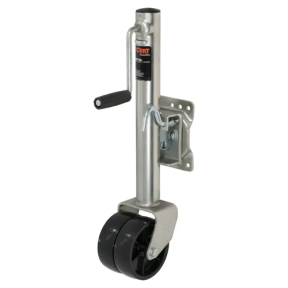
Boat trailer jacks with wheels make ground handling easier once the trailer is off the tow vehicle. They are especially useful in driveways, boat yards, and launch staging areas where small adjustments matter.
- Effortless maneuverability: Roll the trailer by hand on flat, firm surfaces.
- Stable lifting support: Safely raise and support the trailer tongue.
- Simpler positioning: Fine-tune trailer alignment without re-hitching.
Types of Boat Trailer Jacks We Carry
Different trailers and load ratings call for different jack designs. The most common styles balance lift height, load capacity, and clearance while towing.
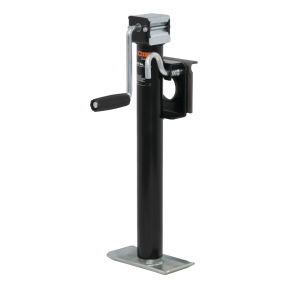
- Swivel Tongue Jacks: Rotate up and out of the way when not in use, improving ground clearance during transport.
- Drop Leg Trailer Jacks: Provide additional lift range and are well suited for heavier trailers or uneven terrain.
Featured Product
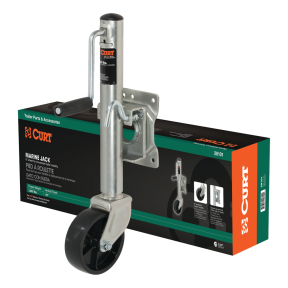
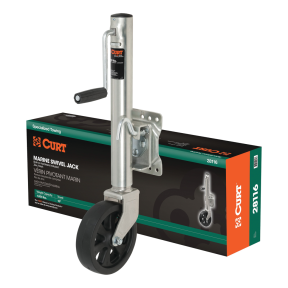
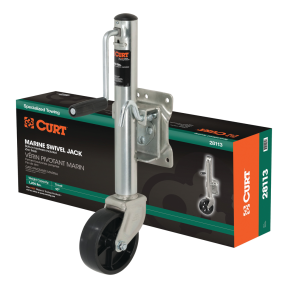
Curt Manufacturing 8" Wheel Marine Jack
- Lift capacity: 1,500 lbs.
- Vertical travel: 10 inches.
- Design features: 8" wheel for easier trailer movement and coupling, with a zinc-plated finish for corrosion resistance.
Why Shop with Fisheries Supply?
For decades, Fisheries Supply has supported boat owners and marine professionals with practical equipment and knowledgeable service. Our trailer jack selection reflects real-world use, not marketing trends.
- Broad in-stock selection: Multiple jack styles, capacities, and accessories.
- Trusted manufacturers: Including Camco and Curt Manufacturing .
- Support for pros and DIYers: Pro accounts available, with nationwide and worldwide shipping.
Choosing a reliable marine trailer jack reduces strain, saves time, and improves safety every time the trailer is handled.
Frequently Asked Questions
How do I choose the right boat trailer jack for my trailer?
Choose a jack based on your trailer’s tongue weight, which is typically 10–15% of the total boat and trailer weight. The jack’s rated lift capacity should exceed that tongue weight, and it should fit your trailer’s tongue style, whether straight or A-frame.
How do I determine the proper lift height and stroke for a trailer jack?
Measure the distance between the trailer coupler and the hitch ball when the trailer is connected. The jack’s vertical travel needs to cover that distance plus enough extra clearance for unhitching and leveling.
What clearance issues should I consider when installing a boat trailer jack?
Check the jack’s retracted height to ensure adequate ground clearance during towing. Also confirm there is enough space for the handle to rotate freely without interference from trailer components.
What is the difference between a swivel jack and a drop-leg jack?
Swivel jacks feature a pivot mechanism that allows the jack to rotate horizontally and lock parallel to the trailer frame during travel, providing better ground clearance. Drop-leg jacks include an inner telescoping tube that can be quickly lowered and pinned into place, which reduces the amount of cranking required to reach the ground and typically offers higher weight capacities for heavier vessels.
Should I choose a bolt-on or a weld-on trailer jack?
Bolt-on jacks are the most common choice for boat trailers because they are easy to install with basic tools and simple to replace if they become damaged or corroded. Weld-on jacks offer a more permanent and theoretically stronger connection, but they require professional installation and are much more difficult to remove or replace later.
What maintenance is required for a marine trailer jack used in saltwater?
Marine jacks should be rinsed thoroughly with fresh water after every use to prevent salt buildup. Periodically disassemble the jack to clean and apply fresh marine-grade water-resistant grease to the internal screw threads and bearings. This prevents the "seizing" commonly caused by the harsh marine environment.
What are the benefits of a trailer jack with wheels versus a foot plate?
Jacks with wheels (casters) are ideal for smaller to mid-sized boats because they allow you to manually maneuver and position the trailer on flat, firm surfaces. Jacks with a fixed foot plate are generally preferred for heavier trailers as they provide a more stable, non-slip base that won't roll or shift while the boat is in storage.