Stay Connected on the Water: Marine Cell Boosters, Routers & Monitors
You’re miles offshore on what should be a routine day on the water when you need to check the weather or call the marina—only to find your phone has no signal. It’s a familiar problem for coastal cruisers and offshore anglers alike, and it’s one of the main reasons marine cell phone boosters have become standard equipment on many boats.
What To Know
- Marine cell boosters extend usable cellular range offshore.
- System choice depends largely on distance from shore.
- Installation quality directly affects performance.
- Integrated routers and displays improve onboard usability.
At Fisheries Supply, we’ve spent decades helping boat owners and installers address marine connectivity challenges. From signal loss offshore to the demands of saltwater, vibration, and weather exposure, our experience shapes how we select and recommend marine-grade communication equipment.
Why Your Boat Needs a Marine Cell Phone Booster
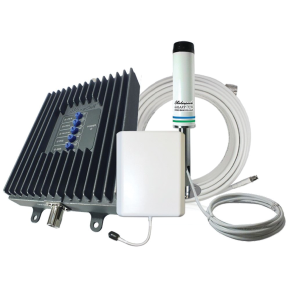
Marine cell phone boosters are designed to capture weak cellular signals using a high-gain external antenna, amplify those signals, and rebroadcast them inside the boat. The result is a stronger, more stable connection for voice and data.
In practical terms, a booster helps your phone maintain usable service farther from shore by improving both incoming and outgoing signal strength. This can make the difference between intermittent service and a consistent connection.
The Benefits Boaters Notice
- More reliable communication: Stay in touch with shore contacts, monitor weather updates, and place calls when timing matters.
- Clearer calls and usable data speeds: Reduced dropped calls, improved voice clarity, and data performance suitable for email, forecasts, and navigation updates.
- Marine-built durability: Equipment engineered to handle vibration, temperature swings, and exposure common in marine environments.
Choosing the Right Marine Cell Booster
Selecting a booster starts with understanding how and where you use your boat. The distance you typically travel from shore-based cell towers is the most important factor in determining the level of amplification you’ll need.
- Standard power amplifiers: Well-suited for coastal cruising, nearshore fishing, and day trips where signals are present but inconsistent.
- High-power amplifiers: Better suited for extended cruising, offshore runs, and commercial use where signals are faint or intermittent 15 miles or more from shore.
Installation Considerations That Affect Performance
Proper installation has a direct impact on how well a marine cell booster performs. Attention to antenna placement and cable routing can significantly improve results.
- Mount the external antenna as high as practical to improve signal capture.
- Install the amplifier in a dry, well-ventilated location below deck.
- Maintain adequate separation between external and internal antennas.
- Use marine-grade cables and connectors designed for long-term exposure.
Complete Marine Connectivity Solutions
Drawing on years of hands-on outfitting experience, we offer a range of equipment designed to work together as an integrated system.
- Marine cell phone boosters: Options ranging from compact systems for smaller boats to higher-output units for larger or commercial boats.
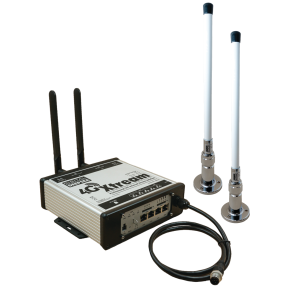
- 4G Wi-Fi routers: Onboard networks that allow multiple devices to share a boosted cellular connection.
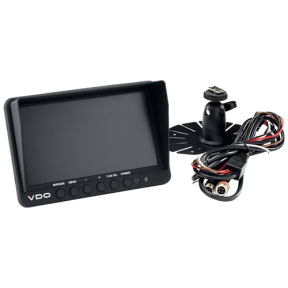
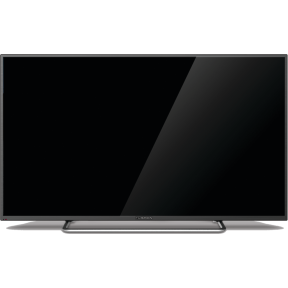
- Marine display monitors: Sunlight-readable displays designed to integrate with navigation and onboard systems.
- LTE signal boosters: Data-focused solutions intended to support higher-bandwidth applications such as chart and weather updates.
Additional resources
You can also explore related onboard systems, including marine stereo systems and boat security cameras, to support entertainment and onboard monitoring.
Frequently Asked Questions
How does a marine cell phone booster work?
A marine cell phone booster captures weak cellular signals through an external antenna, amplifies them, and rebroadcasts the improved signal inside the boat to support voice and data use.
How far offshore can a marine cell booster help?
Performance depends on the booster’s power and antenna setup, but higher-power systems are designed to improve connectivity 15 miles or more from shore when signals are faint.
Why is antenna height important on a boat?
Mounting the external antenna higher improves line-of-sight to distant cell towers, which directly increases signal capture and overall system performance.
Can multiple devices share a boosted connection?
Yes. When paired with a 4G Wi-Fi router, a boosted cellular signal can be shared across multiple onboard devices.
What is the difference between a marine cellular modem and a Wi-Fi router?
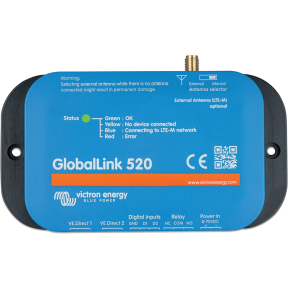
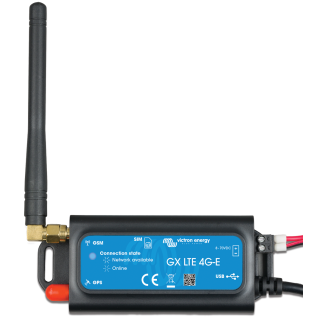
A marine cellular modem, such as those from Victron Energy or Digital Yacht, connects directly to cellular networks to provide a data source. A marine Wi-Fi router then takes that data and creates a local wireless network, allowing multiple devices like smartphones, tablets, and smart TVs to access the internet simultaneously.
Can I use standard home electronics like HDTVs on my boat?
While some residential TVs can be used, specialized marine HDTVs and monitors are engineered to withstand the demanding boating environment. These units are built to handle constant vibration, moisture, and temperature fluctuations that would typically cause standard consumer electronics to fail prematurely.
Where is the best place to install a marine cell booster antenna?
For optimal performance, the external antenna should be mounted as high as possible on the boat, such as on a radar arch or mast, to maximize line-of-sight to shore-based towers. It is also important to maintain adequate vertical or horizontal separation between the external and internal antennas to prevent signal oscillation or feedback.
Are there connectivity solutions for monitoring boat systems remotely?
Yes, many marine connectivity devices are designed to integrate with onboard monitoring systems. For example, LTE-M modems can provide a low-power, long-range connection that allows boat owners to check battery levels, bilge status, and GPS location via mobile apps even when they are away from the dock.